Somers Fire Department History
As told by Past Chief Engineer Harold “Tiny” Parker
Before 1938 when
Somers depended on mutual aid from other towns to help put out fires,
Hazardville was called.
A
couple of things happened on the way to the fires.
Bugbee’s store stood where the parking lot is now in the center of
town.
The Hazardville
department was called one day for a fire in town.
They stopped at Bugbee’s store and asked where the fire was.
The Clerk told them it was in the store where it always is.
Another time while Hazardville was on the way to Somers for a call a
wheel fell off the engine.
All
around it was not a good day.
1937
Before 1938,
Somers had to rely on another town to come to their rescue.
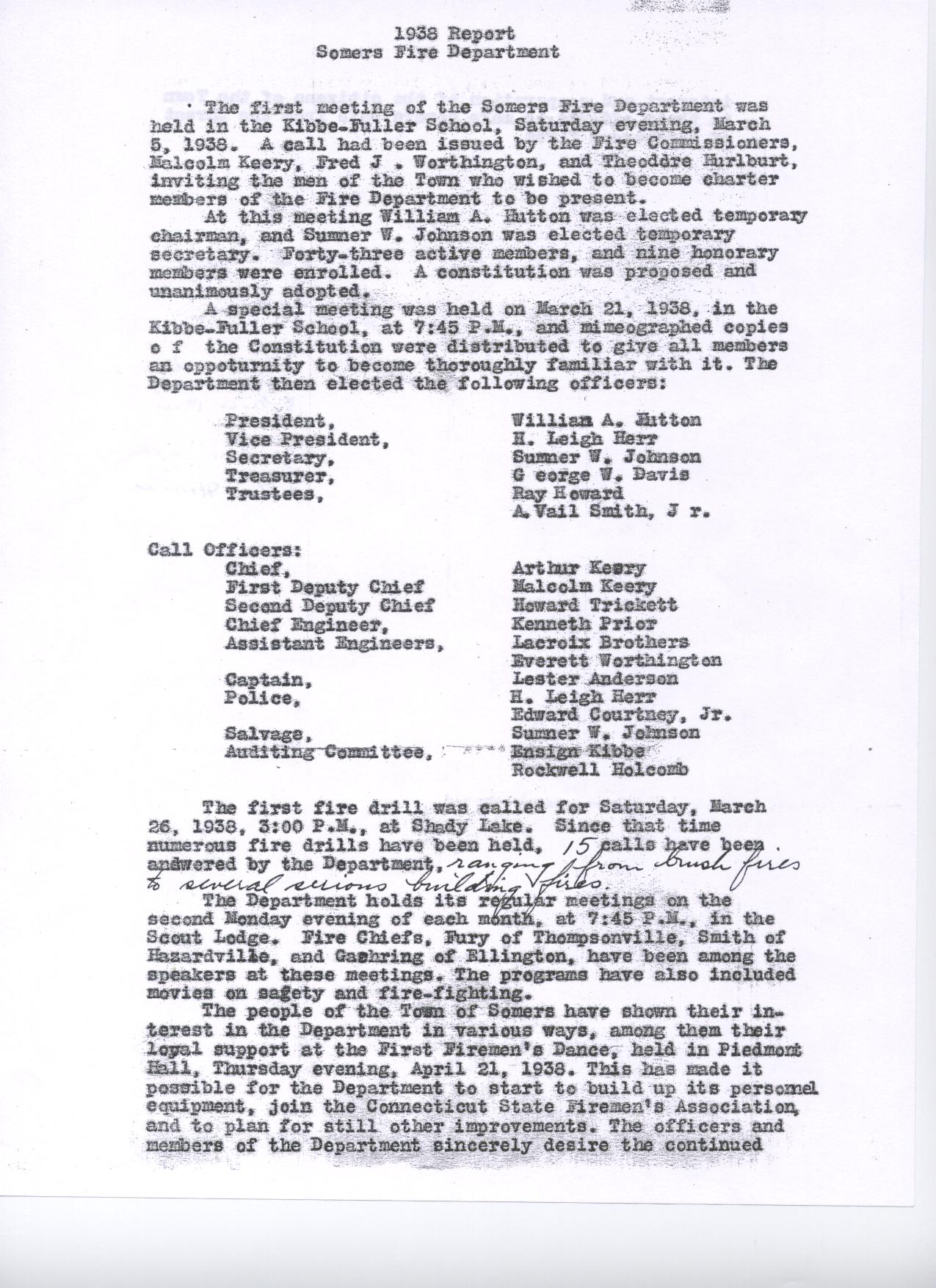
In the winter of 1937, a small group of men got together and formed
the Somers Volunteer Fire Department.
They held their meetings in the building that was called the
mechanics hall.
The hall was a
two story building with one large meeting room upstairs and a pool hall
downstairs that was run by a man named Fred Thiasher.
The building was located about where the Piedmont Hall is now
beside the Town Hall.
When it
was moved, the top half was relocated to Field Road near where
Somersville Auto presently is. It was used first as a
residential house for several years, then was the office of Dentist Dr. Dullea,
but no longer exists.
After the building was moved, the members of the Somers Fire
Department met at the Town Hall until a new building was built.
At one of the first meetings Arthur Keery was elected the first Fire
Chief.
The first Fire
Commissioners were elected consisting of T.J. Hurlburt, Malcolm Keery, and
F.J. Worthington.
A fire truck was
needed and in 1938 a Ford truck with a front mount pump was ordered.
I saw the original billing for the truck about 1979 at the Farrar Co.
where the truck was built.
The
total cost was about $4,500.
The Somers Woman’s Club donated $500 toward the truck.
The fire truck was kept at a Chrysler Plymouth dealership in the
building now housing the Barn Package Store.
The first method
of calling the firemen out to the fire was by running the siren.
After a few years of using this method, they wanted something that
was better.
A telephone system
was put into use.
A phone line
was dedicated for this use and phones would ring in two or four homes.
Whoever had the duty for the day would get the location of the fire
and had a list of fireman to call (probably two to four) who in turn had a
list to call and so on down the line of members.
This worked
fairly well for probably 20 years.
In the 1960’s we went to a unit call the Instant Alert.
Our fire calls were answered in Tolland at the Regional Dispatch
Center and within seconds they could push out a radio signal that tripped
our Instant Alerts in the member’s homes at the same time and we would be on
our way.
1956
By 1956 the
needs of the town were growing.
The department was looking for a new building or a better way of housing our
equipment.
The department truck
at that time was stored at the Chrysler Plymouth Dealership.
Some discussion was had about adding two bays onto the Dealership.
It was now owned by the former mechanic for the Chrysler Plymouth
Dealership.
His name was John
Loneski.
He almost always was
the driver.
It didn’t make any
difference what the weather was, you would see John wearing his baseball cap
and a light jacket in the open cab fire truck.
The department
was also looking for land to buy and build on.
The lot where the police station now stands was offered by the Cemetery
Committee and was accepted by the members and the Board of Selectmen.
Plans were discussed and costs were estimated with the middle two
bays and meeting room decided upon.
First Selectman Mahlen Avery was very instrumental in pushing for the
original two bays.
By September
1956 the new Fire House was dedicated.
A new fire truck
was also being talked about and Farrar Co. told the department that they could
have one built in about 90 days.
The truck committee had been set up in February 1956 consisting of
Chief Alden Avery, Mahlen Avery, Willard Pinney, and Henery Cook.
Three members of the Fire Department were added to the above
committee; Edward Courtney, Matty Patterson, and Tommy Galbraith.
The members of
the department voted to contribute $4000 out of their treasury toward the
new truck.
A 1956 Ford with a
500 gallon per minute (GPM) pump and a 500 gallon tank was ordered for the
sum of $10,500.
This new truck
was kept at the Desso House until the new fire station was built.
The Desso House was where the morning trolley would pick up the milk
from farmers throughout the town.
1958
In 1958 the
first mention of an ambulance for the town of Somers was recorded in the
February meeting of the Fire Department.
The Lions Club was looking to acquire an ambulance and a year later
they got the First Cadillac Ambulance.
It was housed in the old creamery building then owned by the Desso
family.
The group was named the
Somers Emergency Ambulance Service.
They held their
meetings
in the firehouse.
In 1959 a Dodge
Van was bought for $200 from Richard Navakonis to be used as our first
rescue truck.
It has to be
parked crossways in the bays behind the fire trucks to get it under cover.
1963
In 1963 the Fire
Department was asked to take over the running of the ambulance.
Through the dedication of many people, it has progressed through 3
Cadillacs, 1 Dodge Van, multiple Fords, to the two present day Dodge Ambulances.
In the early
60’s we purchased our first tanker.
It was a 1953 Dodge with a 2500 gallon tank.
We had to house it in the old creamery or Desso House.
In the mid 60’s, four additional bays were added
to the Fire Station.
We
were looking ahead as the town was growing and we knew we would have need of
more equipment to service the town.
1967
In 1967 we
purchased another fire truck from Maynard Fire Apparatus Co.
This truck had a 750 GPM pump front mount and 1000 gallons of water.
This set the picture of what was to happen to us over the next
fifteen years.
The truck
chassis was built except for the rear axle.
It seems the government was taking every axle they could get their
hands on for the armed services.
This was the first of many trucks that we had difficulty getting from
the manufacturers.
1970
In the early
70s, the old 1953 Dodge tanker was getting pretty tired and unsafe to be on
the road.
The tank was
transferred to another Dodge with twin rear axles.
This served us for several years.
We used an irrigation pump to transfer water to our other fire
trucks.
In the mid 70s,
we were in need of another fire truck as our 1956 Ford was at its 20 year
mark and had to be either refurbished or replaced.
We put specifications together and went out to bid.
Low bid was in the $70,000 range and went to Sanford & Sons Fire
Apparatus in East Syracuse, NY.
We were lucky and did not have to wait too long past the delivery date for
this one.
It had 1000 gallons
of water and was our first experience with a midship pump.
It was capable of
pumping 1000 gallons per minute.
At this point I
have to go back to our rescue truck the Dodge van.
Deep River, CT was getting a new rescue truck and selling their old
one.
It was a 1955 Chevy with a
closed in body with side compartments.
We were really coming up in the world now!!
I had a full front seat and the passenger did not have to ride on the
box we got with our first rescue tool, a port-o-power 10 ton unit.
By the early
'70s
we were beginning to feel the pinch with this rescue truck and approached
the Selectmen about getting a new one.
Lenord Owens offered
us
a sum in the 8 to 10 thousand dollar range but by the time we took delivery
of this new rescue truck they had agreed to a sum close to $32,000.
It was built on a 1974 International chassis by Providence Body
Company in Rhode Island.
A
curious thing kept popping up on all our conversations with this company.
We had specified a 10 gauge steel body and they would bring up a
thinner gauge at all of our meetings.
On the first inspection, I could not attend so I told Malcolm Keery
to take a micrometer with him to check the gauge on the steel.
Low and behold we found them to be using a thinner gauge.
Luckily, they only had the front panel made up.
They say that particular body piece was in the corner for many years
afterwards.
Now we really
had a heavy duty rescue vehicle with a walk in body, a place where we could
get accident victims out of the weather, and most of our rescue equipment in
the outside compartments.
Parks
Superior Sales was our sales representative for this unit and saved us a
good dollar amount.
Needless to
day, we had to wait quite a while after the agreed delivery date to receive
the truck.
1979
By 1979 our
second tanker was getting too costly to keep up and we put specifications
together for a new tanker.
We
went our usual route of looking at different chassis and decided to go with
a Firestar General Motors.
We
sent out bid invitations to several manufacturers.
In the bid we asked that the 5 star general chassis be bid
separately.
This is where the
fun begins on this one.
We had
talked with GMC in Hartford and they were bidding on just the chassis.
They were so sure that they would get the bid on the chassis that
they put in an order at GMC for a chassis for Somers Fire Department.
When the bids were opened at the Town Hall at the specified time
Farra Co. had bid the chassis considerably lower and also had the low
overall bid.
Now when Farra Co.
put in the order for the chassis at GMC the computer kept saying that it was
already built.
It took over a
year to get this straightened out.
Farra Co. held its bid price for us and we received our present tank
with 3000 gallons of water and a midship pump of 1000 GPM.
We have since refurbished it with a new polypropylene tank as the
steel one was leaking.
The
truck also went to an automatic transmission which was installed by Camerota
Co.
While all of
this was going on we were looking to get a smaller truck for brush fires.
A truck with four wheel drive, 500 gallons of water, and 1000 GPM
front mount pump was desired.
The bid went to Continetal.
The
chassis was delivered and set in his yard for several months before anything
was started.
By this time he
was overextended and went into receivership.
We had a bond to cover this situation and a truck that was bid in at
$75,000 ended us costing the insurer another $35,000 to get it finished.
So we have two units that are 1980 models.
The engine was sent out in December 1996 to have a new aluminum body
and polypropylene tank installed.
1987
In 1987 our
Maynard Ford was 20 years old and not something that we wanted to refurbish.
We started our usual process of visiting other fire departments and
manufacturers to see what was available.
By the end of 1988 we had a good idea of what we would like.
The bids were again sent out and several manufacturers responded.
The low bid was Maxim Co. in Middlebrough, MA.
This truck was built from the ground up.
It is a 4 man cab with 1000 gallons of water and a 2000 GPM pump.
The pump panel is a top mount and puts the operator up in a safer
position to run the truck.
He
also can see the overall operation of the fire ground better.
Also a first was a 4 inch hose that gives us the capability of moving
a large amount of water over a long distance with less friction loss which
in turn lets the pumper work a little easier.
1994
In 1994 our
department had outgrown the 1974 rescue truck.
At this point in time, the prisons were building and to compensate
the town they gave Somers $450,000 for fire department use.
A new rescue truck was drawn up and went to Saulsbury in Tully NY.
Dan Madden drew up the chassis specifications for a Kenworth truck
and it was built and delivered to East Hartford.
Dan checked it all over before it went to New York.
The body is 20 feet long, all stainless, and should last well into
the next century.
1995
By 1995 our 1976
Sanford was rusting out and the tank was leaking water.
We again started to look around for a new truck.
Chuck Woodruff, who works at Westover Field, showed us a set of
specifications for a unit to be built by the government.
For a change they used everything standard.
It came in three versions, one for the Air Force with a four wheel
drive unit and a top mounted pump panel, another for the Army with standard
two wheel drive, and one for the Navy with a side mount pump panel.
We contacted the same salesman we had for the rescue truck who also
sold for KME in Pennsylvania that was building these for the government.
He found that KME was giving municipal governments an opportunity to
get in on the same basic contract as the US government for a little more
money.
Bids went out and no one
could come close to the price from KME.
It is also built from the ground up and has an aluminum body, 750
gallons of water, and top mount pump panel with a 1250 GPM pump.
The $450,000 that I mentioned previously from the state paid for
refurbishing
the tanker, paid
for the new rescue truck, and left about $80,000 toward the new pumper.
We are now in good shape with all of our equipment.
At the same time
that we received the $450,000 the state also allotted about $30,000 for
public safety which allowed us to update our radio communications.
Going back to
the 70s, we were looking to put a two bay station somewhere else in town.
We were mostly considering somewhere in North Somers.
We couldn’t seem to come up with a good place to build.
What did happen was that Bill Patson, First Selectman, offered to
build us two bays in back of the existing station.
This is where we now house our new rescue truck and the tanker
pumper.
In the 80s, the rear TV
room was added.
Looking back
through the years, the department has had several different fund raisers.
They were chicken Bar-B-Qs, dances, turkey shoots, and food booths at
the 4 Town Fair.
Today we
concentrate on two fund raisers.
We have an annual golf tournament in May and bingo at the 4 Town
Fair.
The monies are used to
buy our Class A uniforms.
A
jacket is given to each new qualified firefighter.
We also have a children’s Christmas party and we have a social night
any month that there are 5 Mondays.